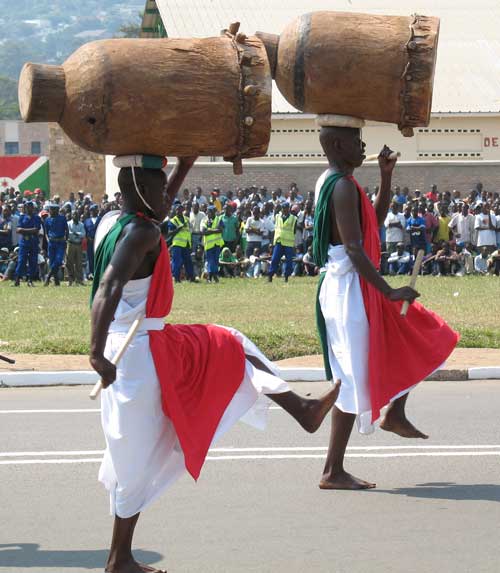
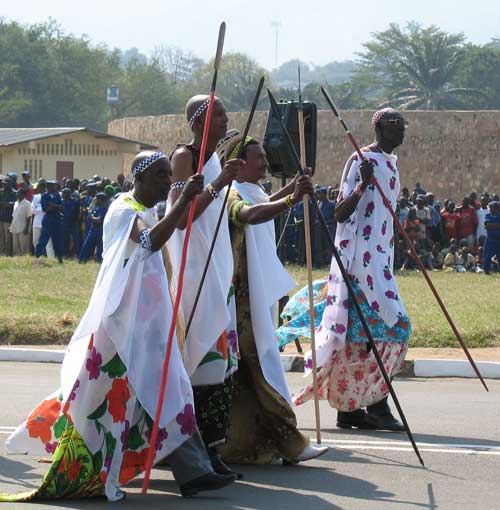
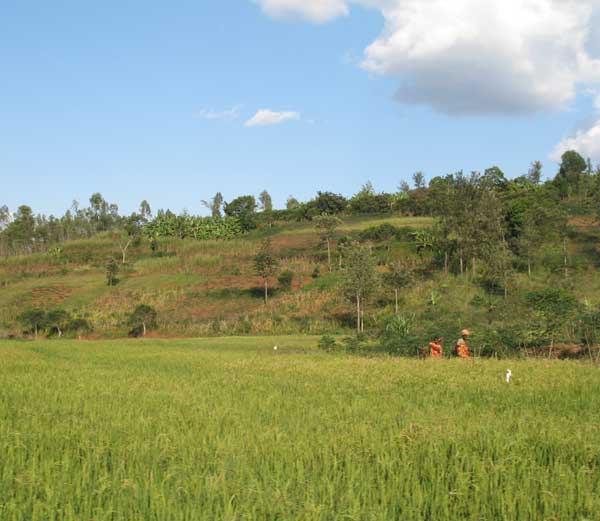
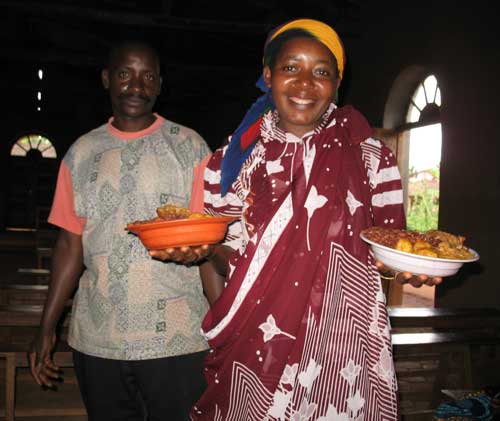
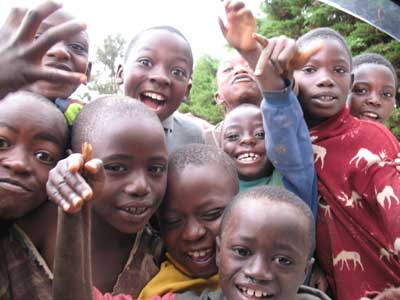
Rwanda_DRC_July08 152So after more travels than I expected (with a surprise trip around Burundi tacked on to my original plan) I am now back in Bujumbura, with computer access which means I will hopefully be able to a little more editing than my last post (sorry!) as well as include some pictures (top to bottom: Lake Kivu, Rwandan countryside, HROC participants and facillitators in Gisenyi, Lac Vert in DRC).

As I mentioned in my last post, tensions between Rwandans and Congolese in the border towns of Goma and Gisenyi are quite tense, and also overlaid by other intergroup (“ethnic”) tensions that were greately exacerbated by the recent conflicts. One person mentioned that in the volcano that leveled part of the city of Goma in 2002, some people said they would rather cross hot lava than cross the border – a bit hyperbolic perhaps, but it illustrates the point.

Rwanda_DRC_July08 046 So does the work of HROC help the situation? In Goma, DRC I attended the third day of a HROC training, at the end of which people testified about how the training had helped them. One woman, who I learned had cried a good part of the second day of the training, told the story of her troubles: She had been married to a person of another ethnicity, and when the violence came her in-laws cast her out along with her 7 children. While later her husband did help some of her children to attend school, it was still quite difficult to feed everyone, and so she had great hope that her oldest child would be able to provide income when she graduated from secondary school. On graduation day, though, her child had suddenly collapsed and died, along with the dreams of her mother.

Like many people who participated, before the training she had not had any opportunity to speak about or explore her trauma, or recognize that trauma is something that needs and can be addressed. The opportunity to share her story with others in the training allowed her to let go of the burden she felt and begin to move forward. She was visibly quite moved, and hers is only one story among many.

The stories of people living in the IDP camps were similarly both grim and also inspiring. People told me horrific stories of fleeing from violence, witnessing the death of loved ones and rapes, and then of the difficulty of living in the IDP camp. In the light of such terror, I wondered if people would find much use for a three-day workshop, and in my questions I also tried to probe whether they would just rather us help them to feed their families, educate their children, and improve the material living situation in the camp.

Rwanda_DRC_July08 119 But I left overwhelmed with the sense that HROC is deeply important to them. While there may be a tendency among participants to tell someone like myself what they presume I want to hear and thus only praise the program, I felt like it was possible to see beyond such superficial displays to get to authentic praise and statements of need. Person after person urged me to do what I could to conduct more trainings for their neighbors and countrymen. Some of them claimed that the trainings were more important than other material resources, because without healing they felt that they could not go on with their lives and thus food and shelter were of no real use.

Consider another example, told to me by a man in the Bulengo IDP camp who in September of last year witnessed 7 people being killed in his village. He and his wife hid behind a latrine while their house was burned, and they managed to flee through the forest and arrived in Goma. Afterward, though, they were so traumatized by this experience that they were not eating nor were they engaged in trying to improve their lives (everyone in the camp has to find some form of work since the food distributed is insufficient to live on). Before the training he wanted to see Rwanda_DRC_July08 216a doctor because he felt like his heart was beating too fast, but after the HROC training his symptoms went away and he shared what he learned with his wife.

Now AGLI has a rule of not giving out stipends to people participating in our workshops (in contrast to other NGOs, which sometimes give quite large stipends), but after the workshop all of his neighbors noticed the change wrought in him by the workshop so clearly that they were convinced that he must have received money. To explain what had instead transformed him, he brought out his workbook from the HROC training and began to teach his neighbors about trauma healing. As he told me this and urged me to help everyone in the camp to receive HROC trainings, he held his HROC workbook in his hand (like many of the participants), tattered from frequent use.
So the past week has been quite busy, as I traveled to Gisenyi in northwest Rwanda then across the Rwanda/DRC border to Goma, from where I visited two internally-displaced persons (IDP) camps and the town of Sake. (For a map of the area, as well as an interesting article about gorillas and charcoal, see the article in this month’s National Geographic).

In each place I visited, I interviewed people who led and who participated in HROC workshops (on reconciliation and trauma healing) to learn about the conflict in the region and about the effectiveness of the workshops. The conflict is quite complex, but for now let me just give a quick overview of the conflict as it relates to Gisenyi-Goma:

People speaking the language of Rwanda, Kinyarwandans, have been living what is now eastern DRC for over 100 years. Some of them migrated when the Belgians wanted to move more labor to the region, others arrived when Tutsi were fleeing violence with the rise to power of Hutu in Rwanda during independence. More Tutsi fled to the region during the 1994 genocide, and as the Rwandan Patriotic Front (RPF) ended the genocide in Rwanda and took control of the government, many Hutu fled to the region, some of whom were involved in commiting atrocities, others just fleeing a feared retribution.

Some of the Hutu who fled formed military forces with the intent of retaking power in Rwanda, which the Rwandan government was none too happy about, and so in 1996, with the stated purpose of overthrowing the ruthless kleptocrat Mobutu Sese Seko, Rwanda and Uganda supported a successful military incursion into what was then called Zaire and installed Laurent-Desire Kabila (the First Congo War). Kabila included many Rwandans in his government, which angered some Congolese to the extent that he removed the Rwandans from their seats. Combined with the fact that Kabila had done little to stop the Hutu militia that still threatened Rwanda, Rwanda and Uganda embarked on a war against their former ally (the Second Congo War or the Great War of Africa). This one did not go so well for them though, as Angola, Chad, and others provided support for Kabila, and so the conflict fell into a stalemate. The countries involved signed a peace accord in 2003 and (largely) got out of the country, though there continues to be discreet involvement through support to rebel groups.

As it stands now (to simplify), the militias operating in North Kivu include the Hutu FDLR (some of whom were involved in the genocide, but many of whom were too young or just not involved), a group led by Laurent Nkunda who makes himself out to be the protector of the (Banyarwanda) Tutsi, and a number of other local militias called “Mai-Mai.” The result is that some Rwandans currently blame the Congolese for not disarming and handing over the FDLR, who they lump together as all being involved in the genocide, while some Congolese blame the Rwandans for invading their country and continuing to support Nkunda.

The resulting ill-will is palpable in Gisenyi and Goma, despite the fact that the two sides of what is really one city are very connected. People from Gisenyi go to the Goma side to do shopping, send their kids to schools in Goma, and so on, while people from Goma go to Kigali for healthcare, and so on. Yet each side blames the other for conflict, and even face being publicly criticized just for their nationality. Next time I will talk about how our workshops are helping to address this problem, as well as the ongoing conflict within DRC.

I’m writing from an internet cafe outside Kigali, where the midi music is blasting, and I only have time for a quick update. Next week I will be headed to Gisenyi in northwest Rwanda and then across the border to Goma in the Democratic Republic of the Congo.

I took the bus up from Bujumbura on Tuesday, about a 6 hour trip, and rolled into Kigali listening to country music such as “She got the rhythm and I got the blues.” That should tell you something about Rwanda – since the genocide in 1994 they have received considerable support from the US and other countries, to the extent that English is far more common than in Burundi. And since they have been rebuilding since 1994, it is definitely more developed than Burundi, from the fancy hotels and bustling tourism of Kigali to the presence of new schools and flower gardens out in the countryside. Which isn’t to say that everything is perfect here, but I have been surprised how, for example, the thinner, drier air here feels more like the air in Denver and makes me feel at home.

Yesterday I traveled with Emily Higgs, a fellow Haverford alum, to the genocide memorials at Nyamata and Ntarama. You can read her description of the memorial, or one of the many other accounts that have been written. Contemplating such horrors is obviously incredibly difficult.

Outside of visiting memorials, as we foreigners go around trying to see the effects of genocide, many find that there is a great disconnect between what occured in 1994 and the current feeling in the air. Perhaps this is also important for people to know, lest they think of Rwanda only as a country of former genocide, rather than as a country with a future.

In Jean Hatzfeld’s book Life Laid Bare, a Rwandan describes why this might be:

Sharing the genocide in words with someone who lived it is quite different from sharing it with someone who only learned about it elsewhere. In the aftermath of genocide, their remains, buried in the survivor’s mind, a wound that can never show itself in broad daylight, before the eyes of others. We survivors don’t know the precise nature of the hidden wound, but at least we know it exists. Those who haven’t experienced the genocide – they see nothing. If they make a real effort, they will one day accept the fact of this secret wound inside us. But that will take quite a while, even if these people are Rwandan or Burundian Tutsi, even if they lost families and close relatives in the killings. (p. 216-217)

So as I visitor here I have found that I must be constantly aware of the limitations of my perspective on what Rwanda has experienced, or is experiencing. No one, it seems, understood the genocide, not even those most involved in it, though they did see it. For outsiders, it is impossible even to be able to see what the genocide was — all we have are images and narratives of surreal events, which when pieced together add up to no coherent or comprehensible view of what the genocide was, or what it means for Rwandans today.

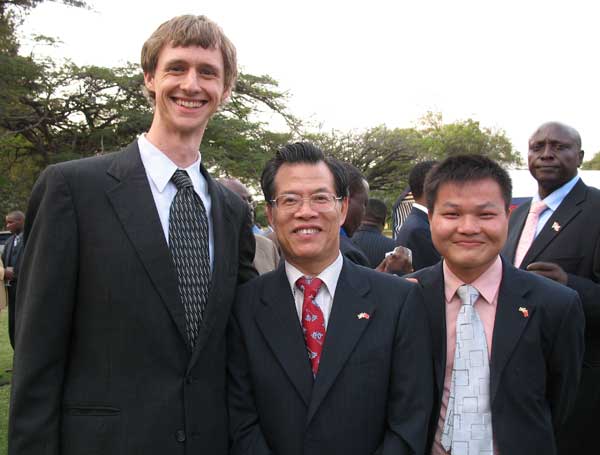
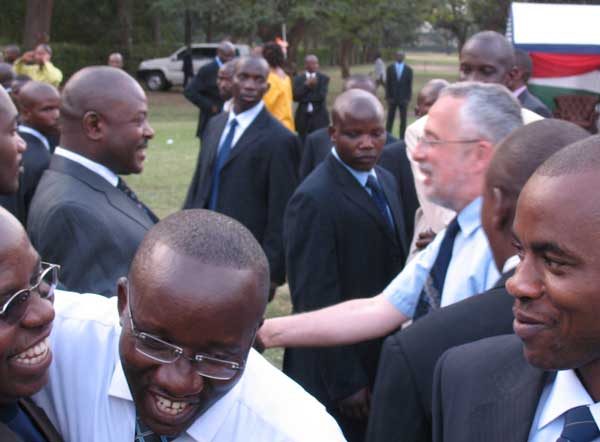
With the Chinese AmbassadorA quick run down of what I’ve been up to lately. First, the rest of the story of Burundian Independence Day, when we went to a reception hosted by the President. The reception was held on the golf course (where I often go running) with an open bar and the wonderful drummers that were also at the parade (see video below). The crowd was filled with members of the military, embassy staff and other government officials, so our mingling was quite fun and the whole atmosphere a bit surreal. I spoke a little bit of Chinese with the Chinese Ambassador and also with a Chinese businessman. When I asked the latter where the best place to get Chinese food was and he gave me a suggestion and then also kindly invited me to his house. I also met the ambassadors for the United States and Britain, a Bishop, and (briefly) Pierre Nkurunziza, the President of Burundi. People took his willingness to mingle with the crowd as another sign of confidence in the current peace. Meanwhile Sara was off dancing with the Minister of Arts and Youth, which a number of people mentioned they saw on TV (as well as us sitting in the stands for the parade).

John meeting Pierre NkurunzizaThen on the 3rd, I went to a 4th of July celebration at the US Ambassador’s house, and met more ambassadors, military personnel, and others. Perhaps the best part though was the brownies and chocolate chip cookies. I met some strange people, such as a military person who had been stationed in the Congo but didn’t actually know where in the Congo he had been, and another military adviser who was training troops for Somalia but couldn’t name a single language they speak there. Suffice to say it was good to be back amongst the Western-educated elite.

On the 4th of July the workcampers and I held a little celebration at our house for about 15 Burundian friends. It was rather hastily organized, but we managed to cobble together a movie and some popcorn, peanuts, sweet bread (a cake approximation), cookies and Fanta. We originally had plans to buy ice cream but it cost $29 for about a pint (I suppose because it has to be refrigerated as it is trucked in from Kenya or Tanzania?). To be honest, the atmosphere felt a little flat until at the end all the Burundians burst into lively song and dance and raised the spirit of the whole evening.

This week I am planning to travel up to Rwanda to do some research for a grant we are working on, so hopefully that will be interesting.

Today we celebrated the 46th anniversary of Burundi’s independence from colonial rule under the Belgians. Pastor Eli made it extra special by arranging a meeting for us on Sunday with a fairly high ranking member of the government who scored us special tickets to see the parade and to a reception hosted by the President. So at 8 a.m. I left with the other members of the AGLI workcamp – Vanessa, Sara, and John (who are here for a month to help build the clinic in Kamenge) to near the stadium where the parade took place. We were seated in a grandstand with some high-ranking members of the military and of the judiciary, next to the grandstand with ambassadors, the President and the legislature.

Also attending this year was the leader of the FNL (the rebel movement now at peace with the government), which made for a historic day, with much hope and joy, and according to Pastor Elie, much more openness and feeling of solidarity within the event.

After everyone had arrived and the flag was raised, the parade began with schools, associations, and representatives of each commune in the city. It included everything from gymnasts jumping through flaming hoops to kids dribbling soccer balls, dancing, and playing tennis over a banner, to drummers who were so flexible that they could kick the drum that was on their head as they walked.

Then we watched more than an hour of the army and police marching by, over 5,000 troops by my estimate. After a while one platoon starts to look about like the next, although one in particular stood out since one of its members had lost his suspenders and his pants were falling lower and lower with each (uninterruptable) step, until they were just above his knees. I suppose a few thousand people might have noticed if he fell out of step to pull them up, but instead those same thousands were laughing at him for a good 10 or 15 minutes.

The president’s speech, which was punctuated with drumming, naturally celebrated the inclusion of the FNL in this year’s event. He speech also seemed to revolve around the idea of recognizing the good in people. He said that Burundians needed to change their culture in that although they often say how wonderful a person is after they are dead, they do not do a good enough job of praising people while they are still alive.

The President then introduced officials from Rwanda and DRC to speak briefly, gave some closing remarks, and the day lacked only (what else?) people driving by on motorcycles at high speed standing up. With one foot in the air, like a yoga pose.

Quite a day, and it’s getting late here, so I will save for another post the story of the reception and meeting President Nkurunziza.

As I sit here typing on my computer in the office of AGLI, with the window open beside me, I can hear cars driving in the street, occasional honking, birds chirping, someone using an electric drill, and someone clicking away at a typewriter. On the balcony across the street from me, a man is talking on a cell phone, and below him someone has installed an air conditioner.

One can see the many faces of technological “development,” even here in Burundi, one of the poorest nations in the world. Though I was around the past decade brought internet cafés, cell phones, more cars and more televisions. And with the prospect of peace looking more promising, people are beginning to think about investing in Burundi again; the Chinese are said to be rebuilding a cotton factory, for example, and the World Bank has plans to invest in various improvements, such as $51 million to rebuild roads.

In asking, “which of these developments are good?” I do not want to deny anyone in Burundi the opportunity to consume anything that I have had the privilege to consume. My point is to pose the question to all of us, “What ought we to consume?” Or if the word “ought” sounds too stuffy, how about “what do we value in our lives?” We can ask this question repeatedly, iteratively, asking of each thing we want, why is it that we want it, and secondly, whether we want the consequences of what we must do (e.g. CO2 emissions or working long hours) to get that which we want.

For example, I value the ability to write on this computer and have it transmitted to my friends and family across the globe in a matter of seconds. Why do I want that? Convenience. Because without it, I would either have to write letters by hand and have them sent by post or I would have to live nearer to my family and friends. The latter would involve certain sacrifices, but it would have benefits as well – I would be able to actually see and hug the people I care about, and many other ways that people are drawn closer by living in the same habitat.

But regarding the former possibility, writing a letter instead, what might the tradeoffs be? Convenience, as I have said, but to what further end, or is that a sufficient good in itself?

If I wrote each letter, I would inevitably be led to change and personalize it, since I had to re-write everything anyway. And I might refine it each time I wrote it, or have new thoughts come into my head. And finally, investing that much time in the production of the writing, I would only include words that were worth the effort, and which would hold their value at least until they were delivered in the U.S.

Alternatively, on days that I had no thoughts that seemed worthwhile to communicate, I might instead turn my attention to the rest of the world around me; I might go out and strike up a conversation with a neighbor, or walk about the town and see what is going on, perhaps in the process running across a friend who I have not seen for a while, or meeting a new friend. Without carrying this train of thought further, I think it’s clear that what was at first a silly question now challenges the way we spend our time. Suddenly we are presented with trade-offs between alternative ways of relating not just to things or tasks but to people, the environment, our culture, and our community.

Although I have no real evidence, I would venture to guess that people in Burundi spend more time with their kids, family, and friends, spend more time singing, more time with their community and know their neighbors better, and consume a lot less of the world’s resources. Now to be fair, you can also look up statistics about healthcare, education, and so on, but is development merely a matter of trading the former for the latter?

Sure, if you want to do more, gadgets and machines can be useful, but what if you want to do better – ecologically, morally, and spiritually?

Now that Burundi seems to be heading in the direction of peace, there are murmurs of having some process to address all the gross violations of human rights that occurred.

If someone asked off hand what should happen in countries where there have been gross violations of human rights – extrajudicial killings, torture, rape, and so on – most of us the in the West are sufficiently indoctrinated in a particular human rights framework to suggest that those who commit such atrocities should be tried in fair courts and serve prison sentences.

Rurengera Friends ChurchThat accords with a sense of retributive justice – that people who do bad things should face, if not an equally bad thing, then at least some kind of punishment. And many argue that such prosecutions are the only way to end impunity and reestablish the rule of law.

But it turns out there may be situations where countries emerging from conflict throw the notion of punishing human rights violators out the window, and have good reason to do so. Consider Mozambique, a country that experienced a quite brutal civil war in which an estimated 800,000 people lost their lives, and then decided simply to grant a blanket amnesty for all atrocities committed by both sides and move on to rebuild their nation. Agreeing to such an amnesty was basically a precondition for achieving a peace accord, and many people seem happy to be focused on the future rather than the past. Instead of trials, they approached the healing of the wounds of war with traditional healing rituals and worked hard to reintegrate the combatants back into their communities.

I take this example from the journalist Helena Cobban’s book Amnesty After Atrocity?: Healing Nations after Genocide and War Crimes. Cobban compares the cases of Rwanda, South Africa, and Mozambique in terms of how they handled human rights abuses and how that affected the movement towards peace in those countries. It’s full of interesting details that I can’t include here, but consider the following:

  1. The International Criminal Tribunal for Rwanda, set up by the UN to try the leaders of the genocide in a Western style court system, cost more than 1.1 billion dollars (by her estimate). How many suspects were tried for that quantity of money? 26. That works out to $42.3 million per suspect!
  2. For comparison, in 2003 Rwanda received $331.6 million in overseas aid, even while, as with most post-conflict countries, the lack of jobs was one of the biggest challenges to peace.
  3. Were people satisfied with this system? An attitudes study in 2002 “found that only 29.2 percent of the Rwandan respondents expressed any degree of approval of ICTR’s record.” (Cobban, p. 194) She found higher approval levels in S. Africa and Mozambique for approaches that didn’t involve such a court system.
  4. The court system itself, with the burdens of proof it seeks to establish through cross-examination, etc., can be re-traumatizing for victims, and through its adversarial approach can emphasize differences between people rather than unite them.

That suggests the case for war crimes tribunals is at least troubling. That said, when (back in DC) I heard Betty Bigombe speak about her experience negotiating the conflict in northern Uganda, she suggested that the threat of being tried on human rights charges helped bring the LRA to the negotiating table. So I don’t mean to suggest this is a simple matter (and of course, I’m not actually against human rights per se, just an overly simplified view of how to achieve them).

A broader approach would include asking about more than just what would end impunity and reinstate the rule of law, such as: (1) what is best for victims, (2) what the opportunity cost of a course of action is in terms of economic development and other forms of reconciliation that could be implemented, and (3) what is best for the nation to achieve and sustain a peaceful future (given that something like 50% of countries relapse into conflict within 5 years of signing peace accords).

With these criteria in mind, how a country deals with its human rights violations may vary from one place to another, and is a decision that might well be left to the people of that country itself (though this is tricky in cases like Rwanda, where the government is not a power-sharing arrangement but instead represents one side of the conflict).

Having dispensed with the Lonely Planet understanding of the differences between Hutu and Tutsi, I thought I might explore a little further the past of these two groups.

In explaining the genocides in Burundi or Rwanda the media sometimes refer to the violence as the result of “ancient tribal hatreds” or “irrational atavistic hatreds.” I earlier challenged this idea, but what exactly was the historical relationship between Hutu and Tusti?

First, a caveat – the nature of this history has itself been a point of contention. The political scientist René Lemarchand points to how both sides have used a mythologized version of history to support their political claims. To simplify, when the (minority) Tutsi ruled the country, then wanted to say, “Look, this whole ethnic problem was just a product of colonialism. Now that the Belgians are gone, Hutu-Tutsi relationships are best forgotten and not discussed (and therefore you won’t mind ongoing Tutsi rule).” Meanwhile the Hutu wanted to say, “the current injustice of Tutsi rule is merely a continuation of what has been going on for many centuries (so the only way to solve it is to have Hutu instead rule the country.)”

The simple answer is, of course, that the truth lies somewhere in between. Relationships between Hutu and Tutsi before the arrival of the colonial powers were not that of perfect equality, but neither were they as problematic as they later became. While differences did exist, the Hutu-Tutsi distinction was not a central dichotomy through which Burundians viewed their lives. Consider the context that is thought to have existed in Burundi in pre-colonial times (See Lemarchand):

  1. There was intermarriage between Hutu and Tutsi, and it was also possible to change between being one or the other. In another sense, one could actually be both, since “Hutu” referred not just to a social group but also to a social subordinate.
  2. There was not simply rule by Tutsi. First of all, there was a separate ruling class, the ganwa, who were considered neither Hutu nor Tutsi, and into which people were elevated from both groups. Furthermore, while Tutsi controlled more of the local chiefdoms than Hutu, there were a nontrivial number of Hutu chiefs.
  3. Unlike in Rwanda, there was a struggle among princes in Burundi (between the “Batari” and “Bezi” clans) that caused them to compete for the allegiance of both Hutu and Tutsi.
  4. Within the royal court, there were ceremonial roles for Hutu, Tutsi and Twa (another minority group that today makes up ~1% of the population).
  5. There was a notion of status that was independent of Hutu/Tutsi. While there was a positive correlation between being Tutsi and being higher status, there were still Hutu that were higher in status than the average Tutsi.
  6. There were kinship identities that were stronger than the Hutu/Tutsi division and which had nothing to do with ethnic membership.
  7. A much-contested issue is that of the patron-client ties that existed between Tutsi and Hutu. These should not, however, be simply understood in the framework of a feudal class-structure. As Lemarchand writes, “To argue, with some Hutu intellectuals, that the patron-client relationship served the Tutsi as a social mechanism for placing the Hutu masses into bondage is arrant nonsense; yet it would be just as naïve and uncritical to assume that patron-client interactions were invariably marked by undiluted social harmony.”

This complexity of relationships and identities suggests that to attribute recent violence in Burundi to ancient hatreds is to falsely read into the past a set of social relationships that developed over time. The current conflict was not ordained by the region’s history; rather it took colonialism and post-independence struggles to forge this distinction into the highly polarizing and contentious issue that it has become, a process which I hope to explore in future posts.

1. Calling the bride a “cow” is normal. Because of their place in traditional society, cows here were (are?) revered animals. In Burundian weddings, the bride’s family usually gives a speech in which they point out that in exchange for the dowry, they promised to deliver the “cow”, i.e. bride. Then they ask the groom’s family to confirm they have made good on their promise. The groom’s family asks the groom whether they have delivered the correct “cow.” The groom looks at the bride and says yes, and the crowd cheers. Also, saying that one has eyes like a cow is a compliment.

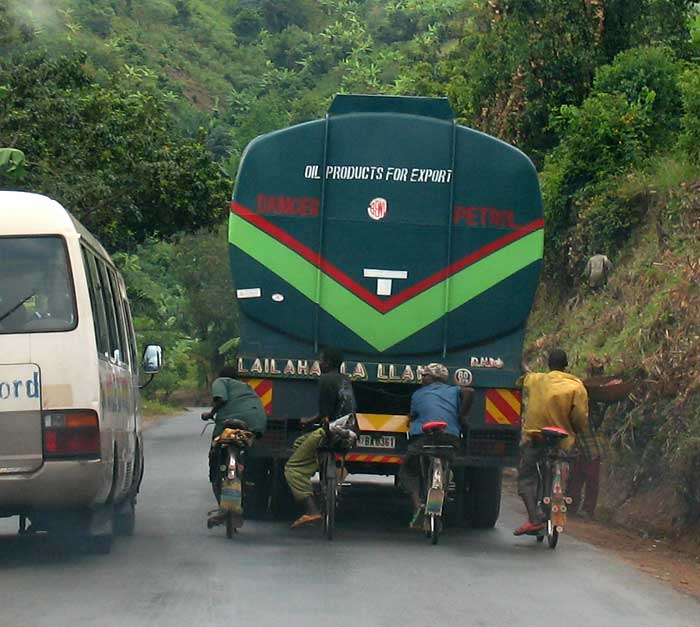
Bicyclists Hitching a Ride2. Bicycles. I’m a big fan of bicycles as a carbon free, exercise-included, fun means of transportation, though one of the challenges can be hauling cargo. I was once pretty proud to get to our garden a 40 lb. bag of compost using my bicycle, but these people put me to shame. In addition to regularly carrying passengers, I’ve seen a people carrying a bench and three or four chairs (they have rear racks that are quite a bit sturdier than you find in the US). Also, as you head up the hills out of Bujumbura, just about every truck that has a handhold is also hauling 3 or 4 bicyclists. They’ve got it down to quite an art – they keep one foot on the pedal and then the other leg they loop over the handlebar or over the top tube to keep them from getting fatigued by the need to lean so far forward. You should see them all lean in unison as they round a sharp corner at 30 mph (cue Huey Lewis’ “Power of Love”…)
3. Greetings. Close friends might greet each other with kisses on alternating cheeks like in many other countries, and strangers in some circumstances greet each other with handshakes. But in friendly settings, even strangers will greet each other with little hugs and then handshakes. Also, people here frequently hold hands when talking with each other, including males. I once had a random guy on the street come up to me and hold my hand for five minutes as he cheerfully talked to me and welcomed me to the city.

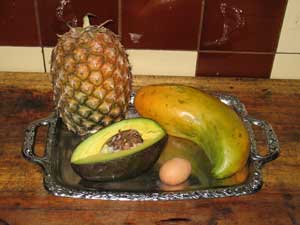
pineapple, papaya, avocado, egg4. Food. I am growing accustomed to eating giant (7’’) avocados, onion salads (no lettuce, just cucumbers or tomatoes on a bed of raw onion) and absolutely delicious pineapple, papaya, bananas, and mangos. In Burundi one is never too young to start drinking “fanta,” which is the general term for both Coca-Cola and all soda/pop drinks, an inversion of the linguistic traditions of the American South. Also different – just about everyone here eats food that is locally grown, unprocessed, and often organic (fanta aside).
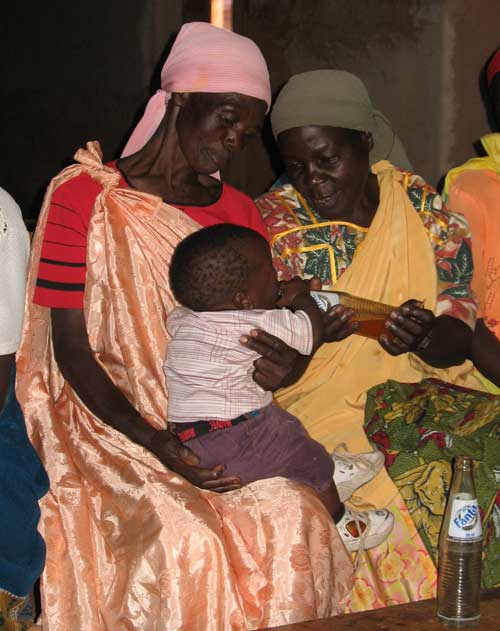
Never too young to start.5. Traffic. Last week in church the pastor wanted to use a metaphor for the signals people receive from God about their leadings, but to do so he had to first spend five minutes explaining that in other countries there are these mechanically controlled lights at intersections, with a red light meaning stop…etc. So traffic lights are a foreign concept. As are stop signs and the expectation of taking turns. Instead, intersections are controlled by a highly complex negotiation, the logic of which has thus far eluded me. For example, if the intersection is of a smaller and a larger road, there seems to be some deference to the larger road, though that may be simply the deference one often gives to a ton of metal heading your way at high velocity.

Now I’ve been to other developing countries before and found the traffic runs a bit differently than in the U.S., but I find riding in cars here a harrowing experience. Not because I fear for my own safety, but because I’m certain we’re going to hit every pedestrian, bicyclist and motorcycle that we pass. Then just as I’m bracing for impact, the sea of human traffic magically parts and we squeak by within inches of people on both sides, none of whom even turns their head. Just another day on the road.

6. Carrying things on one’s head. Burundians seem to carry just about everything on their head, often without using their hands. You see people carrying pots, mats, sugar cane, an umbrella, anything, and man are they good at it. A study of Kenyan woman suggested that they modify their walk in a way that allows them to carry 20% of their body weight without exerting more energy than normal walking (making them far more efficient than any other form of unassisted transport). Last week I saw a guy carrying boxes full of printer paper on his head, stacked 4 boxes high, through the very crowded central market. It was precarious enough that I didn’t stop him to ask why he didn’t just take two trips.

“Trauma” is one of those words we bandy about without thinking too much about what it means or how it affects people. In particular, I mean traumatic stress, a set of physiological, mental, and emotional responses to one or a series of horrible events. I don’t know much about trauma, but trauma healing is a big part of the work that HROC does, so I am trying to learn the basics. My sense is that we should all be a little more aware of it, whether our concern is returning Iraq War vets, domestic violence, the aftermath of earthquakes and tsunamis, or countries emerging from conflict like Burundi.

What we now in the US classify as “Post-traumatic stress disorder” (PTSD) is a concept that has evolved over time from the notion of “hysteria” in the late 19th century that focused on women, to “shell-shock” during WWI, then reaching its present form following the Vietnam War. It can happen to both victims and perpetrators of violence.

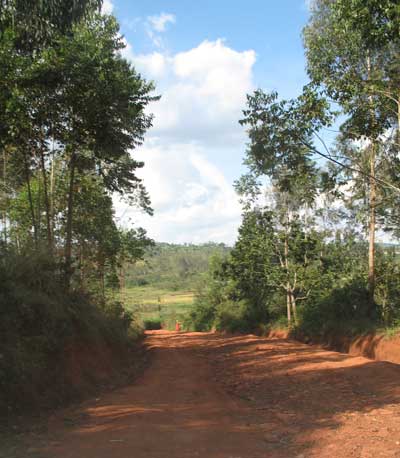
According to Judith Herman, there are three main symptoms of PTSD. The first is being in a constant state of hyperarousal, a nonstop fight-or-flight response that continues long after the threat is gone. TheRoad from Rurengera second is recurring intrusive thoughts and dreams that are so intense the person feels as though they are actually re-living the event. These thoughts are not linear narratives – they contain images and sensations but are fundamentally broken and isolated from the rest of the person’s experience. The third symptom is “constriction,” a sort of paralysis of the mind where the individual avoids thoughts, experiences, and situations that could evoke the intrusive memory, and also can lead people to become numb to all emotions and experiences. The use of alcohol and other drugs by people affected by PTSD may be an attempt to self-medicate themselves to numb their way out of their feelings of helplessness and terror.

Interestingly, these symptoms can lead people either to avoid situations similar to their traumatic experience or to seek them out.

Finally, PTSD dramatically affects people’s ability to function within their family and society since it inhibits one’s ability to make plans for the future and violates one’s basic sense of self-worth. Victims often blame themselves and feel guilty. Traumatic experiences can throw into doubt our notion of basic trust and belief in the nature of the community and world as fundamentally safe and positive.

Whew! But the good news is that recovery from trauma is also possible. Our three day HROC trainings help people to understand traumatic stress and to deal with it. Following Herman, they follow a three-stage process that includes re-establishing a basic sense of trust, giving space for remembrance and mourning, and reconnecting the traumatized with their self and with others in their community.

For example, my coworker Adrien returned from a HROC workshop last week in Rurengera in which a number of people had very moving experiences. One commented (in Kirundi):

These teachings have helped me so much because all that I had lost had made me unable to care about the world. I could not undertake any activity that would require effort from me for I felt that all was futile. Since the war took away my dear loved ones, I decided to get drunk every single day. It is painful, I tell you! It is after participating in this workshop that I have stopped this bad behavior because I understood what was wrong with me. I promise you that I am going back to work instead.

I hope in the coming months to share with you in more depth the experiences of those who are working to overcome their traumatic experiences.

« Previous PageNext Page »